
📝 Article
Motivation: Why Wanting Something Isn’t Always Enough
By Dave Milliken
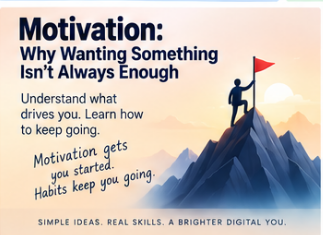
Most of us know exactly what it feels like to want something. We want to get fitter, change jobs, finish a course, learn a new skill, sort out our finances, start a business, write something, repair a relationship, or finally finish the thing that's been sitting half-done for months. Wanting something is easy. Doing something about it is considerably harder, and that gap between the two is where motivation actually gets interesting.
Motivation tends to get treated as though it's simply a feeling, as if successful people wake up every morning genuinely brimming with enthusiasm and leap straight out of bed toward their goals. Real life is considerably less dramatic than that. Some days you feel motivated. Some days you really don't, and the trouble with leaning entirely on motivation as a feeling is that feelings shift constantly. A goal that felt genuinely exciting on Monday can feel a lot less appealing by Thursday afternoon. So perhaps the more useful question was never "how do I stay motivated all the time," but "how do I keep moving on the days motivation isn't particularly interested in helping me?"
What actually motivates us
People respond to a genuinely wide range of things. Money motivates us. So does recognition, fear, competition, curiosity, a sense of responsibility, wanting to help someone else, or simply the desire to get better at something. There's nothing inherently wrong with external rewards, we all have bills to pay, and most of us genuinely appreciate being recognised for good work. But external rewards alone don't tend to sustain effort over the long haul.
Daniel Pink, in Drive, draws a genuinely useful distinction between motivation that's driven mainly by external rewards and motivation that comes from a deeper connection with the work itself, highlighting three ideas in particular: autonomy, the sense that you have some real control over what you do and how you do it; mastery, the desire to get better at something that actually matters to you; and purpose, the feeling that what you're doing connects to something larger than the immediate task sitting in front of you. When those three are genuinely present, motivation tends to become considerably more durable.
Wanting the result isn't the same as wanting the process
This is one of the more uncomfortable truths about motivation. We very often want the outcome considerably more than we want the actual work required to get there. Someone might genuinely want a qualification without particularly wanting to study on a wet Tuesday evening. Someone might want to become a programmer without especially enjoying every error message, every failed attempt, or the hour spent working out why one missing character broke the entire program. Someone might want to get fitter without exercise ever becoming effortless. A goal can stay genuinely attractive while the process required to reach it remains difficult the whole way through, which is exactly why motivation needs more than sheer desire behind it. It needs actual structure.
Goals give motivation somewhere to go
A vague desire is genuinely hard to act on. "I want to improve my life" might be entirely sincere, but it gives you almost nothing to actually work with. Improve what, exactly? By how much? What would improvement even look like, and what happens once you get there? A proper goal gives motivation genuine shape. "I want to learn more about computers" becomes "I want to complete a course in Excel," which immediately opens up better questions: when, how, what do I actually need, and what's the first physical step?
This isn't just a nice turn of phrase either, it's one of the more heavily researched findings in organisational psychology. Edwin Locke and Gary Latham spent decades studying exactly this question, eventually synthesising several hundred separate studies, and found that specific, appropriately challenging goals consistently outperformed vague "just do your best" goals, or no goal at all, in the overwhelming majority of the studies they reviewed. The effect held up across genuinely different domains, business performance, athletic training, academic work, and more. The mechanism seems to be fairly straightforward: a specific goal focuses your attention, pushes you toward more effort, helps you keep going when things get uncomfortable, and forces you to actually think through a strategy rather than vaguely hoping things work out. "Do your best" sounds encouraging. It gives you almost nothing to actually aim at.
But one goal is rarely enough on its own
There's a real problem waiting on the other side of a goal too: what happens once you've actually reached it? Complete the course, and then what? If the course only ever existed as a finish line, motivation can evaporate remarkably fast the moment you cross it. A genuinely useful goal tends to lead somewhere further, complete the course, then use the skill, then take on something more complicated, then perhaps teach someone else, then perhaps progress toward the next qualification. That doesn't mean life needs to become an endless treadmill where every achievement instantly demands another. Quite the opposite, really, it means goals work best as part of a direction rather than sitting there as isolated trophies, and there should always be room to stop, actually enjoy what you've achieved, and honestly decide whether the next step is genuinely worth taking.
Ask why, properly
One of the most useful questions you can ask about any goal is simply "why do I actually want this?" Not the polished answer you'd give if someone asked you directly, the real one. Wanting a qualification might really be about wanting a different job, more confidence, a genuine new challenge, a route into further study, or just proof to yourself that you can actually do it. The qualification itself isn't really the destination there, it's part of something considerably larger, and that connection genuinely matters. When the work gets difficult, having a clear reason gives the goal something solid to hold onto.
Purpose doesn't need to be grand to actually work
Purpose doesn't require changing the world. It can be entirely ordinary: I'm learning this because I want more independence. I'm doing this because I want better opportunities. I'm finishing this because I made a promise to myself. I'm building this because it'll make someone else's life a bit easier. I'm practising because I genuinely want to get good at this. The point is simply that the activity connects to something that actually matters to you, and that connection changes your entire relationship with the work itself. It stops being "I have to do this" and becomes "I'm doing this because it leads somewhere I genuinely care about."
Autonomy matters more than people expect
People tend to feel considerably more motivated when they have some real say over how they approach a task, and that doesn't mean unlimited freedom, most jobs, courses, and responsibilities come with genuine rules attached. But even small amounts of choice can matter: when you do the work, which part you tackle first, how you organise it, which method or tools actually suit you.
Bruce Daisley's The Joy of Work looks closely at how working conditions shape people's actual capacity to do good work, and it's a genuinely important reminder that motivation never exists in a vacuum. Telling someone who's constantly interrupted, exhausted, micromanaged, and given zero control over their work that they simply need "more motivation" is unlikely to solve very much at all. Sometimes what looks like a motivation problem is really an environment problem wearing a motivation problem's clothes.
Motivation needs genuine room to breathe
It's genuinely difficult to feel motivated when every single task feels urgent, hard to concentrate when notifications keep arriving, and hard to make real progress without any uninterrupted stretch of time to actually think. Daisley's work is useful precisely because it reframes the whole question: sometimes the most effective motivational move isn't another inspirational quote, it's turning the notifications off, clearing some genuine time, cutting the number of competing demands, deciding what actually matters today, and then simply beginning.
Mastery creates its own fuel
There's something genuinely satisfying about actually getting better at something. A skill that felt awkward at first eventually starts feeling easy, almost without you noticing the shift happen. You solve a problem faster than you used to. Something that used to confuse you suddenly makes sense. You produce noticeably better work than you did a month ago. That sense of progress can become motivating in its own right, because mastery gives you genuine evidence that your effort is actually working, and evidence tends to be considerably more motivating than encouragement ever is.
Progress genuinely changes how you see yourself
At the start of a difficult task, you usually have very little proof you can actually succeed at it. After a handful of small wins, that changes, and you genuinely start thinking "I can actually do this," not because positive thinking magically rewrites reality, but because your own recent progress is real evidence sitting right there. Someone who's finished ten lessons is in a genuinely different psychological position than someone still staring at lesson one. Progress builds real momentum, and momentum makes the very next action considerably easier to take.
Commitment can help carry you through
Robert Cialdini's Influence explores how powerful commitment and consistency actually are in shaping human behaviour. Once you've made a genuine commitment, especially one you've said out loud or already acted on, you tend to feel real internal pressure to behave consistently with it afterwards, and that pressure can genuinely work in your favour. Writing a goal down, telling someone you trust, enrolling on a course, booking the exam, or simply starting a project all shift something quietly, moving you from "I might do this" to "I am doing this." That shift in identity carries real weight. Commitment shouldn't become a trap, though, sticking with a bad decision purely because you once committed to it isn't perseverance, it's often just refusing to admit that circumstances have genuinely changed. Consistency earns its keep only while the underlying direction still actually makes sense.
Applying real ethical pressure to your own goals
Goals can turn genuinely unhealthy if you never stop to ask whether they're still actually serving you. Someone sets a target, reaches it, then immediately sets a bigger one, then bigger again, and there's nothing inherently wrong with ambition on its own. But a goal can eventually stop being a tool you're using and quietly become something closer to a master you're now serving instead, which is exactly why it's worth applying real ethical pressure to your own goals occasionally: what will actually reaching this cost, who else is genuinely affected, what am I sacrificing to get there, is this still improving my life, would I honestly encourage someone I cared about to pursue it this exact same way?
This isn't purely a personal-development concern either, it's played out at genuinely enormous scale in the real world. In 2016, Wells Fargo was found to have pushed staff toward an aggressive internal sales target, popularly known inside the company as "Eight is Great," pressuring employees to sell as many as eight separate financial products to each customer. Under that pressure, employees ultimately opened around 3.5 million bank and credit card accounts without customers' knowledge or consent, simply to hit the numbers they'd been set. Roughly 5,300 employees were eventually fired, the bank was fined $185 million by US regulators, and the fallout continued for years afterwards, additional settlements, congressional hearings, and a chief executive publicly told by lawmakers he should resign. The goal itself, a specific, aggressive sales target, worked exactly the way specific goals tend to work, focusing enormous effort and attention on hitting the number. It simply never asked, at any point along the way, whether hitting that number was actually still a good idea. A goal can genuinely tell you where to go. It was never supposed to remove your ability to decide when enough is actually enough.
Planning turns motivation into something you actually do
A goal without a genuine plan leaves too many decisions sitting there for "later," and later tends to be an extraordinarily crowded part of anyone's calendar. Planning builds the actual bridge between "I want to do this" and "here's exactly what I'm doing next": tonight, read one chapter; tomorrow morning, spend thirty minutes on the assignment; on Friday, review what actually got done. Once the action becomes specific, it needs considerably less motivation to actually begin.
Make the very next step almost embarrassingly obvious
Large goals can be genuinely paralysing. Write a book. Change career. Build an application. Complete a qualification. Every single one of those is really dozens or hundreds of smaller tasks wearing one big name. When a goal feels too large to even approach, shrink it down and ask what the next physical thing you can actually do is: open the document, write the title, answer one question, send one email, read one page, create the folder, install the software. The smaller that next action genuinely is, the less internal negotiation it takes to actually start.
Your environment is quietly shaping your behaviour too
Cialdini's work is also a genuine reminder that people are heavily influenced by their surrounding context: what other people around us do, what feels normal, what's actually visible, what requires real effort. That means you can deliberately design your own environment to support the behaviour you actually want. Want to read more, leave the book somewhere you'll genuinely see it. Want fewer distractions, physically move the distracting apps out of easy reach. Want to study first thing tomorrow, prepare everything you need tonight. Make the good behaviour slightly easier and the bad behaviour slightly more awkward, and that small difference genuinely compounds. Motivation was never purely something sitting inside you. It's shaped just as much by what's actually sitting around you.
Motivation will disappear sometimes, and that's genuinely normal
There will be days you simply don't feel like doing the thing. That's ordinary, not a warning sign. The real mistake is assuming a lack of enthusiasm means the goal itself no longer matters, when in reality we do plenty of genuinely worthwhile things without feeling remotely inspired in the moment. Sometimes discipline carries you. Sometimes routine does. Sometimes it's just commitment quietly doing the work. And sometimes you simply do ten minutes, because ten minutes genuinely beats nothing at all. Motivation is often what starts the movement. Structure is what actually keeps it going afterwards.
Don't mistake difficulty for failure
Something being genuinely difficult doesn't mean you're doing it badly. Sometimes difficulty just means it's new, it requires real effort, and you haven't mastered it yet, full stop. Unrealistic expectations are what quietly turn ordinary learning into something that feels like failure, expect instant competence, and normal early struggle starts feeling like proof you can't do it. A considerably healthier expectation going in: "I'll probably be genuinely bad at this before I get any good at it," which gives you actual permission to learn rather than demanding you arrive already finished.
Your goals deserve the occasional honest review
A goal you set six months ago doesn't automatically deserve permanent loyalty. Circumstances shift. You shift. Priorities genuinely change. So review your goals every so often and ask plainly: do I still actually want this, does it still lead where I originally thought it would, is there a genuinely better route now, does this goal need adjusting, or does it need abandoning altogether? Stopping something that no longer makes sense isn't automatically failure. Quite often, it's simply good judgement.
Motivation was never really a personality trait
It's tempting to sort people into fixed categories, motivated, lazy, driven, unfocused, when reality is genuinely more complicated than that. The exact same person can be intensely motivated in one area of their life and completely uninterested in another right alongside it. Someone who looks unmotivated might actually be exhausted, confused, overwhelmed, quietly afraid of failing, genuinely unsure where to even begin, or working toward a goal that was never really theirs to begin with. That's precisely why telling someone "you just need more motivation" so rarely helps anyone. A considerably better question is simply: what's actually stopping the movement here?
The important part
Wanting something genuinely matters, it gives you real direction. But wanting alone is rarely enough on its own. Sustained motivation tends to show up when you've got a genuinely clear goal, an honest reason it actually matters, some real control over how you pursue it, a real sense that you're improving, an actual plan, visible progress along the way, an environment that supports the behaviour rather than fighting it, and a genuine willingness to reconsider the goal itself when circumstances shift. Motivation was never about feeling excited every single day. It's about building enough genuine connection between what matters to you and what you actually do next that progress stays possible, even on the days enthusiasm is nowhere to be found. A good goal should pull you forward. It should never just drag you along indefinitely. And perhaps the most useful question was never "how badly do I want this," it's "why do I actually want it, what am I genuinely prepared to do next, and will actually reaching it take me somewhere worth going?"
Further reading
Drive, by Daniel H. Pink, explores intrinsic motivation and the genuine importance of autonomy, mastery, and purpose, particularly in work that involves real thinking, creativity, and problem-solving.
The Joy of Work, by Bruce Daisley, looks at the actual conditions that help people do genuinely good work, concentration, social connection, boundaries, and the ways a working environment can either support or quietly undermine motivation.
Influence, by Robert B. Cialdini, explores the psychological principles that shape behaviour and decision-making, including commitment, consistency, social proof, reciprocity, and authority.
Taken together, these three books offer a genuinely important reminder: motivation was never simply a matter of wanting something badly enough. It's shaped by purpose, environment, behaviour, real progress, outside influence, and the systems you deliberately build around yourself.